If you’ve ever planned a digital marketing budget, you’ve probably faced one of the biggest questions in online marketing: SEO vs Google Ads—which one should you invest in? The answer isn’t as straightforward as it was a few years ago. In 2026, search has evolved dramatically. AI-powered search experiences, Google AI Overviews, smarter bidding algorithms, and increasingly competitive organic rankings have changed how businesses attract customers online. Google itself reported continued growth in Search usage driven by AI experiences, with Search & Other revenue increasing nearly 17% year-over-year, showing that search remains one of the strongest customer acquisition channels available.
Many business owners assume they must choose one strategy over the other. That mindset often leads to missed opportunities. SEO builds sustainable visibility that compounds over time, while Google Ads delivers immediate traffic and measurable leads from day one. Think of SEO as buying a house—it takes time to build equity but becomes a long-term asset. Google Ads is more like renting a premium storefront in the busiest part of town. You gain visibility instantly, but once the payments stop, so does your exposure. The real challenge isn’t deciding which is universally better. It’s understanding which approach fits your business goals, budget, timeline, and industry. Throughout this guide, we’ll compare both strategies using current 2026 insights.
Understanding SEO and Google Ads
Search Engine Optimization (SEO) is the process of improving your website so it ranks organically in Google’s unpaid search results. This involves publishing valuable content, optimizing technical performance, earning authoritative backlinks, improving user experience, and demonstrating expertise and trustworthiness. Unlike advertising, you don’t pay Google every time someone clicks your listing. Instead, you invest in creating a website that Google considers the best answer for users’ questions. Organic rankings typically require patience, but once established, they can generate qualified traffic for months or even years with ongoing optimization.
Google Ads, on the other hand, is Google’s pay-per-click advertising platform. Businesses bid on keywords, and their ads appear above or alongside organic search results. Every click incurs a cost, which varies depending on competition and industry. Google Ads excels because it offers immediate exposure, advanced audience targeting, geographic controls, remarketing capabilities, and extensive performance tracking. Businesses launching new products, promoting seasonal campaigns, or seeking rapid lead generation often prefer paid advertising because results begin almost immediately. In 2026, experts continue to emphasize that SEO wins long-term, while Google Ads dominates short-term lead generation, making the best strategy highly dependent on business objectives.
How Search Has Changed in 2026
The search landscape in 2026 looks very different from what businesses experienced even three years ago. Google is no longer just displaying ten blue links on a search results page. Instead, AI-generated summaries, richer search features, interactive shopping experiences, videos, local business panels, and personalized recommendations compete for users’ attention before they ever scroll to traditional organic results. This transformation means businesses must rethink how they approach both SEO and Google Ads. Winning isn’t simply about ranking first anymore—it’s about occupying as much search visibility as possible.
Artificial intelligence has also changed user expectations. People ask longer, more conversational questions, expecting detailed answers instead of simple keyword matches. Businesses that create comprehensive, trustworthy, and experience-driven content have a greater chance of appearing in AI-generated summaries and traditional search results alike. At the same time, advertisers benefit from Google’s increasingly intelligent machine-learning systems, which automatically optimize bids, audiences, and creative assets to maximize conversions. These innovations mean that neither SEO nor Google Ads exists in isolation anymore. Instead, both have evolved into sophisticated ecosystems powered by AI, user behavior, and first-party data.
AI Overviews and AI-Powered Search
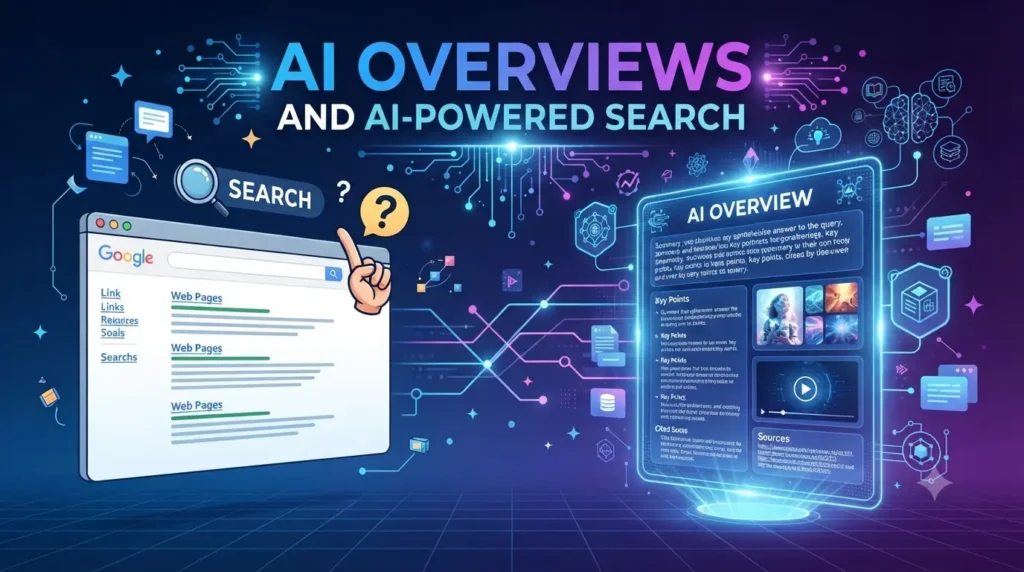
One of the biggest developments affecting SEO vs Google Ads is Google’s continued rollout of AI-powered search experiences. AI Overviews provide users with summarized answers compiled from multiple trusted sources, often appearing before traditional organic listings. For informational searches, users may receive complete answers without clicking any website at all. While this has reduced clicks for certain types of content, it has increased the importance of creating authoritative, experience-based articles that Google’s AI considers trustworthy enough to cite. Businesses that invest in expertise, original research, customer case studies, and detailed guides are more likely to benefit from these AI-powered features than those relying on generic content.
Google Ads has also evolved alongside AI. Performance Max campaigns, AI-generated ad assets, predictive bidding strategies, and automated audience targeting allow advertisers to reach potential customers with greater precision than ever before. Rather than manually adjusting hundreds of settings, marketers increasingly focus on providing quality creative assets, accurate conversion tracking, and compelling offers while Google’s machine learning handles optimization. This automation doesn’t eliminate the need for strategy; instead, it shifts attention toward business goals, customer experience, and high-quality landing pages. In 2026, businesses succeeding with paid advertising understand that AI is an assistant—not a replacement—for strategic decision-making.
Why Search Intent Matters More Than Ever
Keywords remain important, but search intent has become the true foundation of successful digital marketing. Google’s algorithms now understand context, relationships between topics, and the underlying reasons behind a user’s search much better than before. Someone searching “best CRM software” is likely researching options, while someone searching “buy CRM software today” is much closer to making a purchase. Recognizing these differences helps businesses decide whether SEO, Google Ads, or a combination of both will deliver the strongest return.
SEO performs exceptionally well for informational, educational, and comparison-based searches because users are actively researching before making purchasing decisions. Publishing in-depth guides, tutorials, comparisons, and industry insights allows businesses to build trust long before a prospect is ready to buy. Google Ads, meanwhile, excels for high-intent commercial searches where users are prepared to act immediately. Searches containing words like “buy,” “near me,” “pricing,” or “quote” often generate higher conversion rates through paid advertising because they connect users with businesses at the precise moment they’re ready to purchase. Understanding search intent ensures that every marketing dollar—and every piece of content—serves a meaningful purpose rather than chasing traffic for its own sake.
SEO vs Google Ads Comparison
Choosing between SEO and Google Ads becomes much easier when both strategies are evaluated across the factors that matter most to businesses. While they share the common goal of driving qualified traffic, they differ significantly in cost structure, speed, sustainability, and long-term profitability. Instead of asking which channel is universally better, marketers should ask which one best supports their immediate objectives while contributing to sustainable business growth. The comparison below highlights where each strategy excels and where it may fall short depending on your circumstances.
| Factor | SEO | Google Ads |
|---|---|---|
| Initial Cost | Medium to High | Flexible but ongoing |
| Traffic Speed | Slow to build | Immediate |
| Long-Term ROI | Excellent | Good with continuous budget |
| Credibility | Very High | Moderate |
| Scalability | Excellent over time | Excellent with budget |
| Cost Per Click | None | Paid for every click |
| Sustainability | Long-lasting | Stops when spending stops |
| Best For | Brand growth and authority | Fast leads and sales |
Cost
Cost is often the first factor businesses evaluate when deciding between SEO and Google Ads. At first glance, SEO appears free because businesses don’t pay Google for clicks. In reality, effective SEO requires investments in high-quality content creation, technical optimization, website improvements, keyword research, link acquisition, and continuous maintenance. Whether these tasks are performed internally or outsourced to an agency, they represent ongoing investments rather than one-time expenses. The difference is that these investments build a valuable digital asset. Every optimized article, earned backlink, and technical improvement contributes to stronger future performance without requiring payment for each individual visitor.
Google Ads follows an entirely different financial model. Businesses pay every time someone clicks an advertisement, regardless of whether that visitor converts into a customer. Competitive industries such as legal services, finance, insurance, healthcare, and software often experience significantly higher cost-per-click values due to intense advertiser competition. On the positive side, businesses have complete control over daily budgets, campaign schedules, and spending limits. This flexibility allows companies of nearly any size to begin advertising immediately, provided they carefully monitor return on investment. The challenge lies in maintaining profitability while scaling campaigns, as increasing budgets does not always produce proportionally better results without continuous optimization.
Speed of Results
If speed is your highest priority, Google Ads has a clear advantage. A well-structured advertising campaign can begin generating website traffic, phone calls, online purchases, or lead form submissions within hours of launching. This makes paid advertising especially valuable for new businesses, product launches, limited-time promotions, seasonal campaigns, or organizations entering highly competitive markets. Rather than waiting months to establish organic rankings, advertisers can appear at the top of search results immediately by targeting relevant keywords and creating compelling ads. The ability to test messaging, landing pages, and offers quickly is another significant advantage, allowing marketers to refine campaigns based on real customer behavior.
SEO operates on an entirely different timeline. Building strong organic visibility requires patience because Google evaluates website quality, authority, user engagement, and topical relevance over time. Depending on competition and industry, meaningful results may take several months or longer to achieve. While this delayed gratification can be frustrating, the rewards often outweigh the waiting period. Once high-quality pages earn strong rankings, they continue attracting qualified visitors long after publication, generating consistent traffic without paying for every click. Businesses focused on sustainable growth often view SEO as an investment whose value compounds year after year rather than producing only short-term returns.
ROI
When businesses compare SEO vs Google Ads, the conversation almost always comes down to one critical metric: Return on Investment (ROI). Both channels can produce exceptional returns, but they achieve those results in very different ways. SEO generally offers a higher long-term ROI because each piece of optimized content continues attracting visitors long after it’s published. A well-written article targeting a valuable keyword can generate thousands of qualified visits over several years without requiring additional payment for every click. This creates a compounding effect where every new article, backlink, and optimization strengthens the entire website, making future content easier to rank.
Google Ads delivers ROI much faster, but the returns depend heavily on campaign optimization. Businesses with excellent landing pages, compelling offers, strong Quality Scores, and accurate conversion tracking often generate profitable campaigns within days. On the other hand, poorly optimized campaigns can consume advertising budgets quickly without producing meaningful revenue. That’s why experienced advertisers focus less on click volume and more on conversion rates, customer lifetime value, and acquisition costs. In 2026, advanced AI bidding strategies have improved campaign performance significantly, but they still require marketers to provide accurate conversion data and high-quality creative assets.
Scalability
Scalability is another important consideration when evaluating SEO vs Google Ads. Every growing business eventually reaches a point where it wants to increase website traffic, leads, or sales. The question is how easily each marketing channel can accommodate that growth. SEO scales by expanding content, strengthening domain authority, improving technical performance, and targeting additional keywords. As a website gains credibility, it becomes easier to rank for increasingly competitive search terms. Businesses often find that each successful piece of content supports future rankings because Google recognizes the site’s growing topical expertise. This makes SEO one of the few marketing investments that becomes more effective over time rather than less.
Google Ads scales differently. Increasing traffic is often as simple as increasing campaign budgets or expanding keyword targeting. Businesses can launch campaigns in new cities, countries, or customer segments almost instantly. However, scaling paid advertising isn’t always linear. As budgets increase, advertisers may begin targeting broader audiences with lower purchase intent, potentially reducing conversion rates and increasing customer acquisition costs. Competition also plays a role, with rising bids affecting profitability in competitive industries. Successful advertisers understand that sustainable scaling requires continuous testing, audience segmentation, creative optimization, and close monitoring of performance metrics. While Google Ads provides incredible flexibility, businesses must balance growth with profitability to avoid diminishing returns.
Advantages of SEO
SEO remains one of the most valuable long-term investments available to businesses because it creates sustainable visibility that doesn’t disappear when marketing budgets fluctuate. Every optimized page contributes to a larger digital presence that continuously attracts potential customers throughout every stage of the buying journey. Instead of interrupting users with advertisements, SEO positions businesses as trusted resources by answering questions, solving problems, and providing valuable information exactly when people need it. This naturally builds credibility while supporting long-term customer relationships.
Another major advantage is diversification. A strong SEO strategy doesn’t rely on a single keyword or page. Businesses often rank for hundreds or even thousands of related search terms, bringing in visitors from various customer segments. This broad visibility reduces dependence on any single traffic source and creates resilience against changing market conditions. Companies investing consistently in technical SEO, content marketing, user experience, and authoritative backlinks often establish a competitive advantage that’s difficult for competitors to replicate quickly.
Long-Term Growth
Perhaps the greatest strength of SEO is its ability to generate lasting growth. Unlike advertising campaigns that stop delivering traffic once budgets are exhausted, organic rankings continue producing visitors around the clock. An article published today may still generate qualified leads years later if it’s updated regularly and remains relevant. This creates a cumulative effect where every new page strengthens the overall authority of the website. Businesses with extensive libraries of high-quality content often dominate search results across entire topic areas rather than relying on individual keywords.
Long-term growth through SEO also creates predictable customer acquisition. As organic traffic increases, businesses become less dependent on rising advertising costs or changing bidding environments. This stability allows marketing budgets to be allocated toward innovation, customer retention, and expansion instead of constantly replacing paid traffic. While SEO requires patience, consistency, and ongoing optimization, the resulting asset becomes increasingly valuable over time. Many established companies attribute a significant portion of their revenue to organic search because their content continues working long after the initial investment has been made.
Brand Authority
One of the most overlooked benefits of SEO is the authority it builds for a business. When customers repeatedly encounter your website in search results for industry-related questions, comparisons, tutorials, and buying guides, they begin associating your brand with expertise. Trust develops naturally because users perceive organic rankings as recommendations from Google rather than paid placements. This credibility often influences purchasing decisions long before customers contact your sales team or complete an online order.
High-quality SEO also supports every other marketing channel. Articles can be repurposed for email campaigns, social media, sales presentations, webinars, and customer education. Comprehensive content increases backlinks, encourages shares, improves engagement, and positions company representatives as industry experts. In competitive markets, brand authority becomes a significant differentiator because customers increasingly prefer businesses they recognize and trust. Rather than competing solely on price, authoritative brands compete on expertise, reliability, and reputation—all of which are strengthened through an effective SEO strategy.
Advantages of Google Ads
Although SEO delivers exceptional long-term value, Google Ads remains one of the fastest and most measurable methods for generating business growth. Few marketing channels allow companies to reach high-intent customers exactly when they’re searching for products or services. Businesses can launch campaigns within hours, target precise geographic areas, control daily budgets, measure conversions accurately, and continuously optimize performance based on real customer behavior. This level of flexibility makes Google Ads especially valuable for businesses seeking rapid growth or operating in highly competitive industries.
Another important advantage is predictability. Unlike SEO, which depends on search engine algorithms and gradual authority building, Google Ads provides immediate visibility for selected keywords. Campaign performance can be measured in real time, allowing marketers to adjust bids, pause underperforming ads, test new messaging, and improve landing pages continuously. This constant feedback loop helps businesses identify profitable opportunities quickly while minimizing wasted spending.
Instant Visibility
Perhaps the greatest strength of Google Ads is speed. New businesses, startups, and product launches often cannot afford to wait several months for organic rankings to develop. Paid advertising places their offers directly in front of potential customers at the exact moment they’re searching. This immediate visibility can generate leads, sales, appointments, and phone calls almost instantly, making it ideal for businesses with aggressive growth targets or time-sensitive promotions.
Instant visibility also enables rapid experimentation. Advertisers can test multiple headlines, descriptions, offers, keywords, and landing pages simultaneously. Performance data reveals which combinations produce the highest conversion rates, allowing businesses to refine their messaging based on actual customer behavior rather than assumptions. These insights frequently benefit SEO as well, since high-performing ad copy and keyword data can inform future content strategies.
Precise Targeting
Google Ads provides one of the most sophisticated targeting systems in digital marketing. Businesses can reach audiences based on location, device type, demographics, search intent, interests, previous website visits, and countless additional signals. This precision reduces wasted advertising spend by focusing budgets on users most likely to convert. For local businesses, targeting customers within a specific radius can dramatically improve campaign efficiency compared to broader marketing efforts.
Remarketing capabilities provide another significant advantage. Visitors who leave a website without purchasing can later see tailored ads reminding them about products, services, or special offers. Since many customers require multiple interactions before making a purchasing decision, remarketing helps businesses stay visible throughout the buying journey. Combined with AI-driven audience optimization and automated bidding, Google Ads enables businesses to maximize conversions while continuously improving campaign performance based on real-world data.
When Should You Choose SEO?
Choosing SEO makes the most sense when your business is focused on sustainable growth rather than immediate wins. If your goal is to consistently attract qualified visitors without paying for every click, SEO should be a core part of your marketing strategy. Businesses that operate in competitive industries often find that investing in organic search builds a significant competitive advantage over time. While competitors continue increasing their advertising budgets, companies with strong SEO foundations continue earning traffic from high-ranking pages that have already established authority with Google.
SEO is particularly effective for businesses with longer sales cycles. Consider industries like B2B software, healthcare, financial services, logistics, legal firms, or professional consulting. Customers rarely make purchasing decisions after a single search. Instead, they research multiple providers, compare solutions, read reviews, and consume educational content before making contact. Publishing comprehensive guides, case studies, FAQs, comparison articles, and industry insights helps businesses build trust during every stage of that research process. By the time prospects are ready to purchase, they are already familiar with the brand because they’ve encountered its content multiple times.
Another reason to prioritize SEO is cost efficiency over the long term. Although creating high-quality content requires investment, every optimized page becomes a long-term asset. A single article targeting an important keyword can continue generating leads for years if it remains accurate and relevant. Businesses that regularly update existing content often maintain strong rankings even as Google’s algorithms evolve. This makes SEO one of the few marketing investments where today’s work continues producing measurable value far into the future.
SEO is also ideal for companies that want to establish themselves as industry leaders. Ranking highly for educational searches demonstrates expertise, authority, and trustworthiness. Customers naturally associate businesses that consistently appear in search results with reliability and professionalism. This perception extends beyond search engines into sales conversations, referrals, partnerships, and overall brand reputation. In many industries, becoming the trusted source of information is just as valuable as generating direct leads because authority influences purchasing decisions throughout the customer journey.
When Should You Choose Google Ads?
While SEO excels in the long run, there are many situations where Google Ads is unquestionably the better choice. Businesses that need immediate leads, sales, or website traffic cannot afford to wait several months for organic rankings to improve. Google Ads places your business at the top of search results almost instantly, allowing you to connect with customers who are actively searching for your products or services. For startups, newly launched websites, or companies entering new markets, this immediate exposure can accelerate growth during critical business stages.
Google Ads is particularly valuable when promoting limited-time campaigns. Seasonal sales, holiday promotions, event registrations, product launches, or clearance events often have strict deadlines. Waiting for SEO to gain traction simply isn’t practical. Paid advertising ensures your offer reaches the right audience while the opportunity still exists. Once the campaign ends, advertisers can immediately pause spending without affecting other marketing activities.
Businesses operating in highly competitive industries also benefit from Google Ads because organic rankings may be dominated by large, well-established competitors. Rather than spending years attempting to outrank authoritative websites, companies can use paid advertising to compete immediately for valuable commercial keywords. With effective keyword selection, compelling ad copy, optimized landing pages, and accurate conversion tracking, even smaller businesses can compete successfully against larger organizations.
Another major advantage is testing. Before investing heavily in SEO content, businesses can use Google Ads to identify which keywords, messaging, offers, and landing pages generate the highest conversion rates. These insights provide valuable data that can later guide long-term content marketing efforts. Instead of guessing which topics will perform best organically, marketers can make decisions based on actual customer behavior collected through paid campaigns.
Why Combining SEO and Google Ads Delivers the Best Results
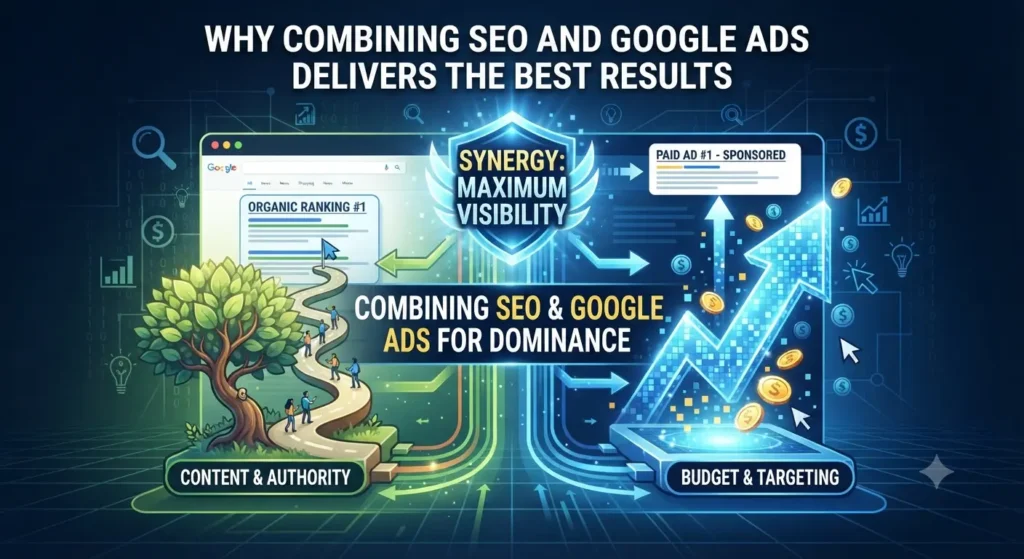
The debate surrounding SEO vs Google Ads often creates the false impression that businesses must choose one strategy over the other. In reality, the most successful companies rarely rely exclusively on either channel. Instead, they build integrated search marketing strategies where SEO and Google Ads complement one another. Each channel fills gaps left by the other, creating a stronger overall marketing system than either could achieve independently.
For example, Google Ads generates immediate traffic while SEO gains momentum. This ensures businesses continue receiving leads even during the early months of an SEO campaign. As organic rankings improve, paid advertising budgets can shift toward highly competitive commercial keywords, remarketing campaigns, or new product launches. Instead of replacing SEO, Google Ads becomes a strategic tool that supports broader business objectives.
The data collected from Google Ads also strengthens SEO. Paid campaigns reveal which keywords produce the highest conversion rates, which headlines attract the most clicks, and which landing pages persuade visitors to take action. These insights can be incorporated into future SEO content, improving organic performance while reducing uncertainty. Likewise, high-performing SEO pages often become excellent landing pages for paid campaigns because they already demonstrate relevance and authority.
Another important advantage is increased visibility. Appearing in both paid and organic search results reinforces brand recognition and credibility. Users who see the same company multiple times within a search results page are more likely to remember the brand and perceive it as an industry leader. Even if they don’t click immediately, repeated exposure increases familiarity, which often influences future purchasing decisions.
An integrated strategy also improves resilience. Search algorithms change, advertising costs fluctuate, and consumer behavior evolves continuously. Businesses relying exclusively on one traffic source expose themselves to unnecessary risk. Diversifying customer acquisition through both SEO and Google Ads creates stability, ensuring that changes affecting one channel don’t severely impact overall marketing performance.
Final Verdict – SEO vs Google Ads
So, SEO vs Google Ads—which one is better for your business in 2026?
The honest answer is that it depends on your goals.
If your priority is building long-term authority, reducing customer acquisition costs over time, and creating a sustainable source of qualified traffic, SEO is the stronger investment. It requires patience and consistent effort, but the long-term rewards are significant. Businesses that commit to publishing valuable content, improving user experience, and earning trust from both customers and search engines often establish a lasting competitive advantage.
If your objective is generating immediate leads, launching new products, testing marketing campaigns, or achieving rapid growth, Google Ads offers unmatched speed and flexibility. It provides measurable results from day one, making it an essential tool for businesses that cannot wait for organic rankings to develop.
For most organizations, however, the highest-performing strategy isn’t choosing one over the other—it’s combining both. SEO builds the foundation, while Google Ads accelerates growth. Together, they create a balanced marketing approach that delivers both immediate performance and sustainable success.
Conclusion
The digital marketing landscape in 2026 is more competitive and more intelligent than ever before. Artificial intelligence has transformed how people search, how Google ranks content, and how advertisements reach potential customers. Businesses that continue treating SEO and Google Ads as competing strategies risk overlooking the powerful synergy they create when used together.
SEO remains the cornerstone of long-term digital success because it builds authority, trust, and lasting organic visibility. Google Ads complements that foundation by delivering immediate exposure, rapid testing opportunities, and scalable lead generation. Rather than asking which channel deserves your entire budget, businesses should evaluate how each contributes to different stages of the customer journey.
Whether you’re a local business, an eCommerce store, a B2B service provider, or a growing enterprise, investing in both organic and paid search creates a diversified marketing engine capable of adapting to changing algorithms, evolving customer behavior, and increasing competition. The businesses that dominate search in 2026 won’t be those choosing between SEO and Google Ads—they’ll be the ones strategically leveraging both.
Frequently Asked Questions
1. Is SEO better than Google Ads in 2026?
SEO is generally better for long-term growth, brand authority, and sustainable traffic. Google Ads is better for immediate visibility, rapid lead generation, and time-sensitive campaigns. Most businesses benefit from using both together.
2. How long does SEO take to show results?
Most businesses begin seeing meaningful improvements within 3 to 6 months, while highly competitive industries may require 6 to 12 months or longer. Results depend on competition, website quality, and the consistency of optimization efforts.
3. Are Google Ads worth the money?
Yes, when campaigns are properly optimized. Businesses with effective keyword targeting, compelling landing pages, and accurate conversion tracking often achieve an excellent return on investment through Google Ads.
4. Can small businesses compete using SEO?
Absolutely. Small businesses often succeed by targeting long-tail keywords, creating locally relevant content, optimizing Google Business Profiles, and demonstrating expertise within niche markets rather than competing directly for broad, highly competitive keywords.
5. Should I stop Google Ads once my SEO improves?
Not necessarily. Many businesses continue using Google Ads to promote high-converting keywords, launch new products, remarket to previous visitors, and maintain maximum visibility alongside strong organic rankings.